How Does Molecular Diagnostics Support Precision Medicine?

Time:2026-11-09 Author:Henry
0%

Precision medicine uses biological differences to guide prevention, diagnosis, and treatment. Molecular diagnostics examines DNA, RNA, proteins, or other biomarkers to reveal those differences. A tumor sample, for example, may contain a genetic variant linked to a particular therapy. A blood test may detect changes that tissue sampling cannot easily capture. These results can help clinicians select treatments, avoid unlikely benefits, and monitor disease over time. That matters.

So, how does molecular diagnostics support precision medicine? It turns laboratory findings into information that may shape individual care. The process often includes choosing a suitable test, interpreting its result, and considering the patient’s symptoms, history, and preferences. A detected biomarker does not automatically guarantee that a treatment will work. Some tests have limits, and results can vary with sample quality, disease stage, or the assay used. Not always straightforward.

Reliable use depends on validated methods, qualified laboratory teams, and clear communication between clinicians and patients. A result should be interpreted in context, not treated as a complete explanation of someone’s health. Negative findings can also be difficult to interpret: they may mean a target was not detected, rather than proving it is absent. This distinction deserves more attention. By connecting molecular evidence with clinical judgment, diagnostics can make care more tailored and measurable, while leaving room for uncertainty and informed discussion.
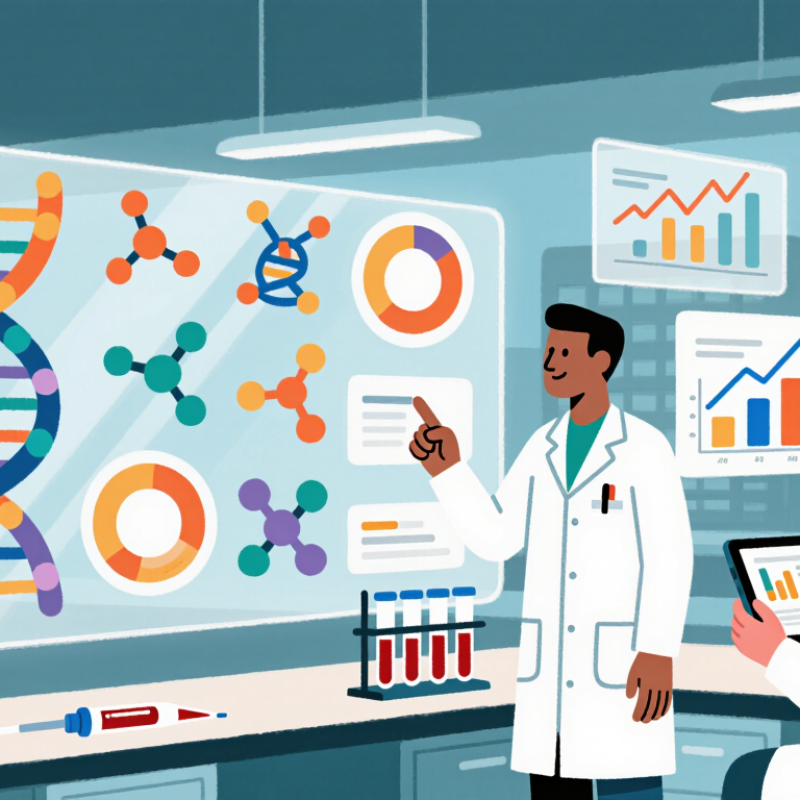
How Does Molecular Diagnostics Support Precision Medicine?

Molecular Diagnostics: Core Concepts and Clinical Purpose

Molecular diagnostics examines DNA, RNA, or proteins in a patient’s sample to help explain disease. In cancer care, a test may detect a gene variant in a small biopsy, or identify a fusion that routine microscopy cannot reveal. These findings can help clinicians classify a tumor, estimate inherited risk, or match patients with treatments targeting specific changes. The Personalized Medicine Coalition’s 2023 Progress Report found personalized medicines represented about one-third of novel drug approvals that year. That trend shows why reliable molecular results matter in clinical decisions.

The result is one piece of evidence, not a treatment plan. Clinicians interpret it alongside symptoms, pathology, family history, and other test results. Professional guidance from the AMP, ASCO, and CAP emphasizes validated testing and careful interpretation of cancer biomarkers. Yet samples may contain too few tumor cells, and different parts of a tumor can carry different changes. A negative result does not always rule out a useful option. Context matters. This is where precision medicine can feel less precise than its name suggests.

Tips: Ask what the test can detect, what it may miss, and whether the result could change care. Confirm that the sample is suitable and the findings are interpreted by qualified professionals. Small details matter. A clear discussion of uncertainty can be as useful as the result itself.

Key Technologies for Detecting Molecular Changes

Molecular diagnostics turns a biopsy into a map of specific changes. PCR can detect known mutations quickly, while next-generation sequencing (NGS) checks many genes at once. In a pathology lab, a thin slice of tumor tissue may reveal a variant that changes treatment options. Small details matter: damaged tissue or too few tumor cells can weaken a result.

The National Cancer Institute’s Cancer Genome Atlas profiled more than 11,000 patients across 33 cancer types, helping researchers connect molecular patterns with disease behavior. For an individual patient, NGS may identify mutations, gene fusions, or copy-number changes. Fluorescence in situ hybridization can locate rearrangements under a microscope. Yet a detected change does not always predict benefit. Biology is messier.

Liquid biopsy offers another route. It measures tumor-derived DNA fragments in blood, which can help track change when a tissue sample is hard to obtain. But low DNA levels may hide a mutation; a negative result is not always reassuring. In the NCI-MATCH trial report, genomic testing successfully profiled 5,540 tumors, and about 18% of patients were matched to study treatments. That gap is worth reflecting on: better detection does not guarantee a useful therapy.

How Does Molecular Diagnostics Support Precision Medicine? - Key Technologies for Detecting Molecular Changes

Technology Molecular changes detected Typical approach How it can support precision medicine Key considerations
PCR and quantitative PCR (qPCR) Known DNA variants, selected gene rearrangements, and changes in nucleic-acid quantity Amplifies selected DNA or RNA targets; qPCR estimates target quantity during amplification. Can test for a specific, clinically relevant variant or help monitor a known molecular marker over time. Targeted tests generally detect only changes included in the assay; results depend on sample quality and assay design.
Digital PCR (dPCR) Known low-frequency variants and small differences in target copy number Partitions a sample into many reactions and estimates target concentration from positive and negative partitions. May help quantify a known variant in samples with a low proportion of altered DNA, including some circulating-DNA applications. Usually requires prior knowledge of the target and does not provide a broad survey of unknown variants.
Next-generation sequencing (NGS) Multiple sequence variants, insertions or deletions, selected rearrangements, and copy-number changes, depending on assay design Sequences many DNA or RNA fragments in parallel using a targeted panel, exome, or broader sequencing approach. Can identify multiple potential biomarkers from one sample and help match findings to evidence-based treatment options or clinical trials. Coverage varies by panel and specimen; some findings may be uncertain, and sequencing does not detect every type of molecular change equally well.
Fluorescence in situ hybridization (FISH) Selected gene rearrangements, amplifications, deletions, or chromosome-level changes Fluorescent probes bind to specific DNA sequences within cells or tissue sections. Shows where a targeted change occurs and can help assess its presence in individual cells, including within a tissue sample. Probe selection determines what can be detected; interpretation may depend on signal patterns, cell counts, and laboratory criteria.
RNA sequencing and fusion testing Gene-expression patterns, RNA variants, and expressed gene fusions, depending on the test Analyzes RNA to measure transcripts or identify sequence junctions created by certain rearrangements. Can reveal which genes are actively expressed and detect some fusions that may inform diagnosis or treatment selection. RNA can degrade during handling; expression levels vary by tissue, cell type, and biological conditions.
DNA methylation analysis Methylation patterns at selected DNA regions or across broader genomic regions Uses methods such as bisulfite-based analysis or methylation arrays to assess chemical marks on DNA. May support tumor classification, research into gene regulation, or selected biomarker assessments when clinically validated. Methylation patterns are tissue- and context-dependent; clinical meaning depends on the specific validated test and intended use.
Immunohistochemistry (IHC) Abundance and location of selected proteins in cells or tissue Uses antibodies and a staining reaction to visualize target proteins in a tissue section. Can provide protein-level biomarker information that complements DNA or RNA testing and helps guide certain treatment decisions. Staining intensity and interpretation can be affected by tissue handling, scoring rules, and biological variation.

Test selection and interpretation depend on the clinical question, specimen type, assay validation, and relevant clinical guidelines. A molecular finding alone does not determine treatment.

From Patient Sample to Diagnostic Result

How Does Molecular Diagnostics Support Precision Medicine?

From Patient Sample to Diagnostic Result

A molecular diagnostic result begins with a carefully collected sample, such as a small blood tube or a tissue section. Its journey to the laboratory depends on accurate labeling, suitable storage, and clear clinical information. A misplaced label or delayed shipment can complicate interpretation. Small details matter.

In the lab, staff extract DNA or RNA and check whether the sample is suitable for testing. Depending on the clinical question, they may use PCR to detect selected genetic changes or sequencing to examine a wider range. Controls help reveal contamination or technical failure. Even so, no test is flawless. A sample may contain too little target material, or a change may fall outside the test’s scope.

The laboratory reviews the findings before issuing a report, including relevant limitations. A detected variant does not automatically explain a patient’s symptoms or determine treatment. Its significance depends on the evidence, the person’s medical history, and sometimes further testing. That distinction can be easy to lose when a report contains unfamiliar terms. Clinicians discuss the result with patients and consider how it fits their situation. A result is one piece of evidence, not the whole picture.

Using Molecular Findings to Guide Treatment

How Does Molecular Diagnostics Support Precision Medicine?

Using Molecular Findings to Guide Treatment

A molecular test can turn a biopsy or blood sample into a treatment clue. It may identify a tumor alteration linked to a targeted medicine, or a gene variant that changes how a patient processes a drug. That matters. The Personalized Medicine Coalition’s 2023 report classified 17 of 45 novel drug approvals as personalized medicines. The figure shows how treatment options increasingly depend on biological findings, not diagnosis alone.

Clinicians interpret results alongside symptoms, medical history, and the quality of the sample. The FDA’s pharmacogenetic associations resource documents gene–drug relationships that can inform medication choice or dose. A result may help avoid an ineffective treatment, but it cannot promise success. Some findings have unclear significance, and access to testing varies. A report can also feel more certain than the evidence behind it. That deserves reflection. In practice, teams discuss whether a finding changes care now, whether more evidence is needed, and how the patient weighs benefits and risks. A molecular result should guide a conversation, not replace one.

Clinical Applications and Challenges in Precision Medicine

Molecular diagnostics supports precision medicine by examining DNA, RNA, or proteins for clinically relevant clues. A tumor biopsy, for example, may reveal changes that help clinicians consider targeted treatments. Genetic testing can also inform inherited disease assessment or indicate how a patient may process certain medicines. In infectious disease care, molecular tests can identify a pathogen and sometimes help guide treatment choices. These results add evidence, not a prescription. A test cannot capture every feature of a person’s health.

Clinical use depends on the question being asked and the quality of the sample. A small or damaged biopsy may not provide enough material, and results can arrive too late to guide an urgent decision. Some findings have uncertain significance, while a negative result does not rule out every relevant change. Cost, access, privacy, and the need for genetic counseling also matter. It is tempting to treat a molecular result as definitive; in practice, clinicians weigh it alongside symptoms, imaging, family history, and patient preferences. That judgment can be difficult.

Tips: Ask what decision the test could change, and when results are expected. Confirm how uncertain findings will be explained. Keep the conversation open: evidence evolves, and today’s answer may need review as new information appears.

Clinical application: Cell-free DNA testing can help tailor prenatal care by estimating the likelihood of fetal trisomy 21. In a meta-analysis of singleton pregnancies, the pooled detection rate was 99.7% and specificity was 99.96%.

Challenge: This is a screening test, not a definitive diagnosis. False-positive or inconclusive results can occur, so results may require confirmation with diagnostic testing. Performance can also vary by population and clinical context.

Source: Gil et al., Ultrasound in Obstetrics & Gynecology (2017), systematic review and meta-analysis.

FAQS

What is molecular diagnostics?

It examines DNA, RNA, or proteins in a sample. These clues can help explain disease, but they are only part of the picture.

How can molecular testing help guide cancer care?

A biopsy may reveal a tumor change linked to a treatment option. Clinicians weigh that result alongside symptoms, pathology, and medical history.

Does a molecular result guarantee that a treatment will work?

No. A result may suggest an option, but it cannot promise success. Biology is rarely that tidy.

What can affect the accuracy of a test result?

A small or damaged biopsy may contain too few tumor cells. Different areas of one tumor may also carry different changes.

Does a negative result rule out every useful treatment?

No. The test may miss changes, especially when the sample is limited. Ask what the test could not detect.

What does an uncertain finding mean?

It means the evidence does not yet show what the finding means for care. New research may change its interpretation.

Can molecular testing help with conditions beyond cancer?

Yes. It can help identify some infectious causes or assess inherited risks and how a person may process certain medicines.

What should patients ask before testing?

Ask what decision the test could change, when results may arrive, and how uncertainty will be explained. Also discuss sample suitability, privacy, cost, and access.

Conclusion

Molecular diagnostics examines DNA, RNA, proteins, and other molecular features to help explain the causes and characteristics of disease. Technologies such as sequencing, polymerase chain reaction, and gene-expression analysis can identify mutations, biomarkers, and patterns of activity that may not be visible through conventional tests alone. The process begins with collecting and preparing a patient sample, then analyzing it with an appropriate method and interpreting the findings in the context of the patient’s health.

Understanding how does molecular diagnostics support precision medicine begins with its ability to connect a person’s molecular profile to clinical decisions. Results can help clinicians select treatments more likely to work, avoid options that may be less suitable, and monitor how a disease responds. These approaches are used across areas such as cancer care, inherited conditions, and infectious diseases. Their promise depends on reliable testing and careful interpretation, while challenges include sample quality, access, cost, data complexity, and the need to consider each result alongside other clinical evidence.

Henry

Henry

Henry is a dedicated marketing professional with a profound expertise in the company's offerings. With years of experience in the industry, he possesses an impressive understanding of the market dynamics and consumer behaviors that drive success. Henry is committed to sharing his insights through......